• May 2016
    M T W T F S S
     1
    2345678
    9101112131415
    16171819202122
    23242526272829
    3031  
  • Archives

  • Categories

Game Anatomy: The Morph Gun

In between trying to “git gud” at Dark Souls (and generally failing miserably), I’ve been playing a few other games to keep my nerves from fraying.  Thanks to this past couple of weeks being really emotional because of my day job, positive, not negative, Dark Souls has been harder to play right now.  So, mostly, I was playing WoW, but on Friday, I picked up Uncharted 4, and I got a bit nostalgic for my childhood and I started to think about one of my favorite games of all time.

Jak_II_front_cover_1_(EU)

Copyright Sony and Naughty Dog. PAL version for cover because it’s cooler. Also, I’ve literally never seen it before.

Man, that’s a big picture.  Sorry 56k people.  Anyway, Jak II remains one of my favorite 3D platformers of all time, and that’s saying something because it came out during a golden age of these things in the early to mid 2000s on the Playstation 2.  Sly Coopers, Jaks and Ratchets and Clanks were all amazing games, but there was something about the Jak trilogy that stood out, particularly the last two, and a lot of that, I think, comes down to the power of the morph gun.

The morph gun itself isn’t the whole story.  See, Jak and Daxter: the Precursor Legacy is a pretty standard Rare inspired 3D platfomer.  It’s fun, responsive and has this great gimmick where all the levels are sort of actually connected to each other, making it into one expansive world.  It also wasn’t very unique.  Sly Cooper had its stealth and Ratchet and Clank had the crazy guns, but Jak and Daxter just had Daxter.  It was Banjo Kazooie, with slightly more charisma.  So, they switched things up with Jak II, taking cues from Grand Theft Auto III, then a huge deal, and making an actual open world map.  They also made Jak a more rough and tumble character.  They did this by taking away Jak’s Mario inspired Eco powers and giving him a gun, the Morph Gun.

What was cool about the Morph Gun is that it’s somewhat unique, even today, and it managed to stand out from Ratchet and Clank, the other gun based 3D platformer.  Where Ratchet and Clank had their insane guns that did all sorts of different things and filled so many mechanical niches (which, by the way, deserves its own article one day), the Morph Gun was just a regular gun with four modes: shotgun, carbine, machine gun and rocket launcher (sure, scattergun, blaster, vulcan barrel and peace maker).  It didn’t really do anything different, but it didn’t need to.

Morph_Gun_Jak_II

Image copyright Sony and Naughty Dog

See, what makes the Morph Gun so genius is that does two things, one being more important than the other.  The first is that it allows for Naughty Dog to take the Eco Powers from the last game, expand upon them, and create new encounters for Jak to deal with that are more complex.  That’s the one that’s not important, because this is a sequel, and that’s just good sequel making.  The other thing it did was make Jak unique, because it sure as hell wasn’t that stupid soulpatch.

Jak, in the first game, is agile and quick and a hell of a lot of fun to play.  Very few video game protagonists move as well as ones made by Naughty Dog, and in a lot of ways, Jak is the pinnacle.  Unfortunately, in the first game, he is super bland.  Like, take the blandness of Nathan Drake and crank that up to about three Nathan Drakes.  He looks almost like a skin you can buy from an open resource library.  It’s kind of sad.  However, sticking the morph gun in his hands gives him personality.

It’s not just the look of the gun, although making sure it looks roughly the same in every mode is pretty smart.  Nor is it that Jak can switch the weapon around at will, although that’s kind of why it works so well, and allowed Naughty Dog to better tailor their encounters than Insomniac were able to with Ratchet and Clank.  No, what it does is it completely alters Jak’s attitude.  Jak became a new character in Jak II, and the gun ins the main reason for this.  Each mode has a different animation for how it’s used, from the scattergun’s lever action spin after each shot, or Jak’s precision aim on the blaster, it shows how much Jak, as a person, has changed.  Getting Red eco doesn’t change how Jak moves, but he’s going to shoot his peace maker in a different way than any other weapon and that’s going to show more of his change in personality than the underused Dark Jak super mode.

Too often, character animations are overlooked, but Naughty Dog understands them.  More is said about Jak’s new character by how he holds and uses his gun, and showing how hard and tough Baron Praxis’s torture has made him.  This makes him the super soldier, and nothing else.

Speculation: Using Social Links to Improve Gaming

So, nobody read the the last article, but that’s okay, because I still have more to say.  One of the things I touched upon is how well the Social Link’s worked for Persona 4 and how well it could work for other games in the genre.  As an example, I’m going to be using Mass Effect, specifically 2, as a means of showing how the game could be improved by using the Social Link, or a system similar to it, in order to help tie the rest of the game together.  As an aside, the germ of the idea was planted in my head by Egoraptor in an impromptu AMA he did on the Game Grumps subreddit.  I couldn’t actually find the original comment, because it is SUPER buried, but he said it first.  So, without further ado, here we go.

476573-persona_4_the_animation_ed2_large_03

Image Copyright Atlus and Anime International Company Inc.

One of the reasons I’m using Mass Effect is because Yu and Commander Shepard actually have a lot in common, at least, as far as RPG protagonists go.  They’re primary interest is about connecting with their crew and trying to make their lives better.  They’re also courageous ultimate heroes, to which no one can really compare in universe to, but that’s more of an RPG trope than anything having to do with what they have in similarities.  The other reason is because Mass Effect is billed as a game about choices and character, and yet, it doesn’t do as good a job.  I choose 2 specifically because I think it’s far and away the best in the series, and because while the optional stuff is technically optional, it’s not really.  I wrote about it in Game Anatomy how the Loyalty Missions did a really good job of tying Shepard to her party, but I feel like there could have been more, and the Social Link system is the way to do it.

So, one of the problems with the game is that Garrus is always calibrating.  I mean, normally Vakaraian makes the best boyfriend in the game (sorry Gay Male Shepard fans, but it’s true and you know it, but at least Cortez is a close, close second), but he spends all his time in the back fiddling with the damn guns.  Part of this is because the game is open and he quickly runs out of shit to say.  The other problem is that his story is a few conversations, with no wrong answers, a mission that, by the standards of the game, is okay at best (and I can’t remember, despite having the wiki entry on it open and reading it) and then he bones you (or you get high fives if you’re a dude?  I don’t truck with stuff that’s not canon).  I mean, that’s it.  I guess in 3 we get a pretty tearful ending, but that happens regardless of what I do.  Commander Shepard deserves better than this.

mass-effect-3-the-real-female-shepard

She deserves better.  Image copyright EA, Bioware and Bleeding Cool

With a Social Link style system, I’d actually have to talk to Garrus about who he is.  See, Garrus wants to be Batman.  He’s a trained soldier who wants to use his training for violence for a good purpose, and he acts as something of a foil to Wrex, Tali a little bit and even Shepard herself.  He doesn’t really know what his purpose is, because his whole life has centered around violence, and that’s kind of an inherently destructive thing, but what he wants is to help people.  He’s tried everything: the military, the police, even working with Shepard once before, and with the exception of Shepard, none of it has worked.  He says it’s because he only sees black and white, but Garrus is really less of a moral absolutist than he lets on.  His issues are many fold, but one of the major ones is that he doesn’t really see the big picture.  It’s why Fade betrays him, it’s why his crew is wiped out and it’s why everything falls apart on him.  He can’t see the bigger picture.  Here’s the thing though, he’s got talent for being a squad leader, but only if he’s loyal (only Miranda can survive being squad leader without being loyal).  With Shepard’s guidance, he can actually do it.

In the vanilla game, all Shepard has to do is run him through a mission and he’s good.  That…sucks.  No, seriously, it sucks and it’s only partially because Garrus’s loyalty mission is among the more boring in the game.  A Social Link system would set up the discussions to be timed at certain points.  If you haven’t reached those points, with flags both in the game and in Garrus’s in-game story, when ever you talk to him, all you get is a couple of pre-recorded lines.  First, these lines change.  Each step of the way, he’s going to have a different set of lines, plus he’ll have a few generic ones that, since it’s Garrus, are actually hilarious.  Also, unless he has something very specific to say, he’s not going to start the dialog cutscene, and will instead speak as if he were a regular NPC.  This, by the way, applies to all of the members of the crew.  I’m just using Garrus because he’s the best.

When the player gets to the flagged sections, then they have to have a real conversation about what happens, and Shepard needs to actually try to help Garrus with his problems.  She needs to show him what it takes to be a leader, and this means the player is going to need to make choices.  These aren’t Paragon or Renegade choices, but they can be, although, for simplicity’s sake, let’s make it so her stock responses are different based on which side is the highest, but whatever, this is a fantasy, let’s go all out.  There are also Paragon and Renegade versions of the right choices.  Here’s the thing, you need to tell Garrus what he needs to see.  The problem is his world view, he knows what he wants, but he doesn’t know how to get there, and Shepard can’t just placate him.  That’s not her job.  Instead, she needs to show him how to be the right kind of leader, to see the forest and the trees and know how to communicate both to his people.  If you screw up, the game flags two choices, the back up conversation, or it goes forward.

If it goes forward, the storyline continues.  If the player fucks up, then you get a second chance.  In this second chance, it’s a different conversation, not a replay of the last one, which is built on the choice Shepard gives.  There could actually be a number of reasons for this: a Paragon Shepard choosing the correct Renegade choice and Garrus not buying it, saying something that is outright stupid, or just confusing the poor bastard and making him doubt himself.  This second conversation will only advance if Shepard is willing to tell Garrus what he needs, but if it fails, then you can’t ever make Garrus fully loyal.  You can get his mission, you can still make him your boyfriend and maybe he’ll survive the Suicide Mission, but he becomes and unknown factor now.  If you screw up, a third line of conversations run through the rest of the game.

Perhaps, for the forgiving players, maybe if Shepard corrects her choices, she can get back to the top conversation track and make him fully loyal.  That’s going to be complicated, but not impossible.  One the whole, this, I feel, ties the game in more together, and makes the shooty-shooty parts less distinct from the talky-talky bits, and that’s a huge hurdle the game had overcome.  Now, if only there was a way to fix that third game.

Game Anatomy: Social Links

Persona 4 has been called, for good reason, the best JRPG ever made.  The gameplay is top notch, the characters are some of the best in video games and the story is a lot of fun.  Any accolades it gets, it deserves, and one of the things that gets talked about a lot as an example for being good is the Social Link system, which was an expansion over the previous game’s version of the same system.  The Social Link isn’t just great for Persona, either, it’s one of the best examples of roleplaying and conversation systems in RPGs, and it’s a shame more games don’t actually utilize it, or something similar to it.

Most of the time, during a Game Anatomy, I talk about how the system worked well, or made, the game it comes from, and we’ll do that here, but the thing about Social Links is that they’re an outgrowth of something of a problem within RPGs, Japanese and Western, and that’s character interaction and roleplaying.  RPGs are not, and cannot be, table top roleplaying games, and as such, it means the interactions between characters within the narrative is going to be a lot different from how it would be done in a table top game, even if RPGs are attempts at replicating or emulating that experience (in various ways, each which change depending on the game).  Most games have the player make a decision and maybe it will connect with a karma meter or a personal connection meter with a party member.  It’s good, but it’s not great, and in a lot of games (read: everything from Bioware) it’s more of a side thing than something that’s full integrated into the system.  Mass Effect’s dialogue wheel is great, but it’s a limited form of interaction for both the player and the game.  I can use it to make sure the Iron Bull or Tali fall in love with me, or get slightly different reactions from characters, but that’s it.  It has only a limited impact on the game.  The Social Links aren’t like that.  They’re directly integrated into the whole experience of the game, and while it may not completely alter scenes, that’s not what’s important about the Social Links.  They alter the gameplay, tie the narrative to the gameplay, and work together with both of these thematically, but before we talk about that, we need to talk about Yu.

476573-persona_4_the_animation_ed2_large_03

Image Copyright Atlus and Anime International Company Inc.

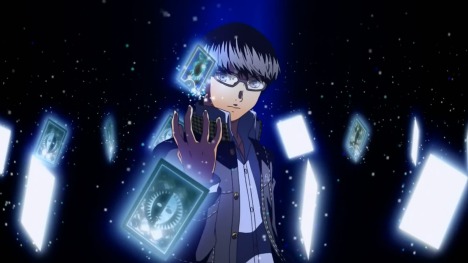
That’s Yu Narukami, the protagonist of Persona 4 and all around good guy.  Sure, he’s a silent protagonist who mostly serves as a cipher for the player to hang out with a bunch of cool people and fight demons, but Yu actually manages to have some character.  He’s a man with heart and courage, and I don’t mean that in the generic hero meaning, I mean this guy is a better candidate for the Heart ring than Ma-Ti is.  Yu genuinely cares about people, and (if you play him right), isn’t going to mince words or screw around with them, either, because sometimes, people need to know the real, unvarnished truth, because that’s what the game is about.

The way the game does this is through Social Links, which is a multi-level system where, after a certain number of conversations with a character, Yu grows closer to them.  When Yu hits a milestone in their relationship, that Social Link grows.  This does include dating, and it means the closer you are with a party member, the better you work together in combat (You became friends with Yosuke.  Yosuke will now die for you) and it sounds a lot like how Dragon Age does it, but it’s not.  It’s better.

The first reason it’s better is that it’s not about buttering up someone with gifts or agreeing with them until they’re your best friend.  See, Persona 4 isn’t about that kind of bullshit.  It’s about the truth, and sometimes, Yu needs to tell something they need to hear, whether they want to hear it or not (and a lot of times they don’t).  The major theme of this game is that humanity has darkness inside of them, and everyone, no matter who you are, as some sort of darkness festering inside them and it cannot be conquered.  No one is ever going to get rid of that darkness inside them, because that darkness is them.  It’s the part of them they don’t like, they don’t want to hear and don’t want to recognize is a part of them, but no one is going to be a stronger person if they don’t recognize that’s a part of who they are.  In Persona 4, Yu becomes friends with people by helping them confront the darkness within them and accepting who they are.  He does this by listening to them, then saying what they need to hear.  They don’t always like this.  Sometimes it straight up pisses them off, but they recognize it’s right and that you’re not trying to hurt them, and they come around.

Here’s the thing, though, Social Links are not automatic.  The player needs to make Yu say the right thing, and the player can screw it up.  This means the player also needs to be caring and attentive, just like Yu (or they can use a guide, but most of them really aren’t hard to figure out).  The player is directly responsible for making sure that Yu does the smart thing, and the Link will not advance if the player doesn’t give them what they need.  It’s not a binary pass/fail, either.  It’s a spectrum.  Yeah, there’s an optimal path, but one wrong response won’t ruin a friendship, and it makes the relationship feel that much more nuanced and organic.  As a player and as a character, Yu must guide his friends and family through real conversations to get to know them, and help them confront who they really are.

The second reason it’s better than Dragon Age, or anything else in RPGs (except maybe Witcher III, but Witcher III isn’t as well written as this.  This is not a complaint against Witcher III) is because it’s directly tied into the game’s narrative.  The game puts the player on a time limit: there’s a year of game time, and each day, the player only has a limited number of things they can do, and this includes going to fight monsters and save people.  One of the big issues with a lot of other RPGs is that the PCs relationship with the rest of the party is sort of separate.  It’s completely optional, and leads to optional quests, and while it’s less pronounced in some games (Mass Effect 2), it’s completely obvious in others (Dragon Age: Origins and Inquisition).  Outside of a few comments from some characters, it’s completely divorced from the rest of the game, but in Persona 4, becoming friends with people IS the whole game.  Each Social Link is its own story line, and while technically optional, each of these storylines converge with the main narrative.  They don’t just connect thematically, they connect with the overall narrative too, and not just party members, Dojima and Nanako, although for them, the connection is a lot more direct.  Each PC (after Yosuke and Chie) have their own dungeons, and bosses that are their darker natures.  Their Social Links, which are established AFTER you defeat their Shadow selves, are about coming to terms with that darkness and how they relate to the group and the overall mystery.  Sure, maybe the sports guys or the drama club girl (I’ve never actually joined band club in this game) may not tie directly into the mystery, but they help Yu grow as a person and further his character development.  They, also, of course, tie in thematically, but we’ve covered that.

From there, though, there’s even more to it.  The story takes this and integrates it into the game.  The PCs are powered by extra planar monsters that give them magic and super powers, allowing them to fight and save people in the game’s dungeons.  Yu has the extra special ability to change out these monsters, called Personas, and can build new ones.  He’s limited, however, in his ability to craft new ones by his level and his Social Link score.  See, each monster has its own Arcana, relating to Tarot cards.  Yosuke is the Magician, Dojima is the Hierophant and Rise’s is the Lovers, and different Personas correspond with the different Arcanas.  The stronger your bond with a person of that Arcana, the stronger Personas of that Arcana you can make, and the stronger your Personas of that Arcana are.  Yu is literally as strong as his friendships.

There’s more to this, and since Persona 4 is one of those games I keep attempting and never seem to beat, there’s more that even I don’t know about.  Still, it’s the best way to do interactions with the various characters in the games.  It needs to be a direct integration, both with gameplay and the actual story.  If the player misses out, it’s their fault for not being friends with the other people.

Game Anatomy: Fulton Extractions

Oh God, I hope this one makes sense.

All right, so, it’s no surprise that Metal Gear Solid 5: the Phantom Pain has been one of my favorite games in years.  Dark Souls III might actually begin to overtake that, or at least get close to it, but I do know that both are going to wind up in my top 10 games of all time, because they’re both rad as shit.  However, I think one thing that I feel like doesn’t get discussed enough about MGS 5 is the fulton extractions.

1027926873

Image copyright Gamepressure and Konami. This article may, or may not, have been written simply to post an image that looks like this

So, a lot of MGS 5 is based on kidnapping people, doing something to them, and then making them a part of your mercenary army.  Then, the more you have, and the better they are, the better your army is.  The better your army is, the better Snake is at his job.  It’s possible to play the game without ever upgrading your weapons, but you’re going to be at a severe disadvantage, among other things, but even having access to the cooler weapons and multiple ways of approaching the game requires a better support team.  This is completely ignoring that it costs money to even play the game (in game money) and without a successful mercenary company raking in the dough, it’s hard to actually get involved, and the best way to get the best soldiers is to kidnap them.

One of the things that MGS has always tried to do was encourage a nonlethal playthrough.  Partially, this is done to subvert player expectations and genre conventions, which actually does a good job of making a deeper story.  Snake, whether we’re talking Big Boss, Solid or Raiden (he briefly had the codename), are not traditional action heroes.  They don’t quip, they don’t really like killing (except Raiden, and, well, he doesn’t like that part of himself) and they have more in common with Sam Vimes than they do with James Bond, ironically.  It’s also to tie in to the thematics, which are about how soldiers, despite ostinsibly being trained to be killers, are still people, even if the world uses them up and tries to make them into something else.  This is part of the reason people don’t actually like the story of Metal Gear Rising.  The idea here is to create an action hero who is genuinely heroic and moral, even if they’re not exactly good people.  Big Boss wants to create a horrible hellscape, but he himself has a sense of honor, Raiden wishes to overcome his darker urges and Snake, well, Solid Snake is just a genuinely good guy.  This is why Big Boss is convinced that Snake wouldn’t have made the same choices he had.  Big Boss is right, by the way, but that’s not the scope of this article.

Since the second Metal Gear Solid, the game has attempted to incentivize  pacifist runs through various means, whether an unlock, different cutscenes or changes to dialogue (which even appears in the first game).  MGS 5 manages to get it right.  Technically, this first appeared in Peace Walker, but Peace Walker’s Militaries San Frontiers lacks a lot of the technical depth of Diamond Dogs, and that’s why the fulton recovery is so central to the game, and to the themes of the series.  Snake is trying to help people.  It’s a broken and twisted way of doing it, but Outer Heaven, and the Mother Bases that precede, are supposed to be havens for soldiers who have nowhere else to go.  It’s sort of an after school activity for wayward soldiers.  Whatever it is to say about Diamond Dogs, they’re at least more heroic than Rogue Coyote (murder children) and the Soviet Army (read history), and it manages to give the soldiers you take at least something positive for them to work for.  Snake is legitimately trying to make the world a better place, he’s just kind of doing it in a ass backwards kind of way.

maxresdefault (1)

Legitimately trying to make the world a better place.  Image copyright IGN and Konami

In order to ensure you actually do this, though, the game does a really good job of making the players actually want to kidnap people.  First, this means equipping nonlethal weapons.  This means that the player is somewhat limited in their approaches, since explosives are right out (for the most part…), and it also means that the games will be a lot harder, especially if you get caught by the Long Range Recon Patrol dudes, who were my bane in Afghanistan.  However, by doing this, and making a point of using nonlethal or CQC attacks, the player is rewarded by increasing the power of their armies.  Powering up the army leads to new weapons, like the rocket arm and the nonlethal rocket storm, new weapons for buddies, like a silent tranquilizer rifle for Quiet, and new abilities and approaches, like the ability to alter the goddamn weather.

Sure, killing all the bad guys might be easier, and a lot of them probably deserve it, but there is a better way.  It’s not perfect, but it is for the themes of the game, and what the series is trying to say about people and soldiers.

Design a site like this with WordPress.com
Get started